

First Stage Of A Process
Design thinking is a methodology which provides a solution-based approach to solving problems. It's extremely useful when used to tackle circuitous problems that are ill-defined or unknown—because it serves to empathise the human needs involved, reframe the problem in man-centric ways, create numerous ideas in brainstorming sessions and prefer a hands-on approach to prototyping and testing. Learning nearly the 5 stages of pattern thinking will empower you and allow you to utilise the methodology to your work and solve complex problems that occur in our companies, our countries, and across the world.
Design thinking is a not-linear, iterative process that can have anywhere from three to vii phases, depending on whom you talk to. We focus on the five-phase design thinking model proposed by the Hasso Plattner Institute of Pattern at Stanford (the d.school) considering they are earth-renowned for the fashion they teach and apply blueprint thinking.
The five stages of design thinking, according to the d.school, are:
-
Sympathize: inquiry your users' needs.
-
Define: land your users' needs and problems.
-
Ideate: challenge assumptions and create ideas.
-
Image: start to create solutions.
-
Test: attempt your solutions out.
Let's dive into each phase of the design thinking process.
What are the 5 Stages of the Design Thinking Process
Stage 1: Sympathize—Research Your Users' Needs
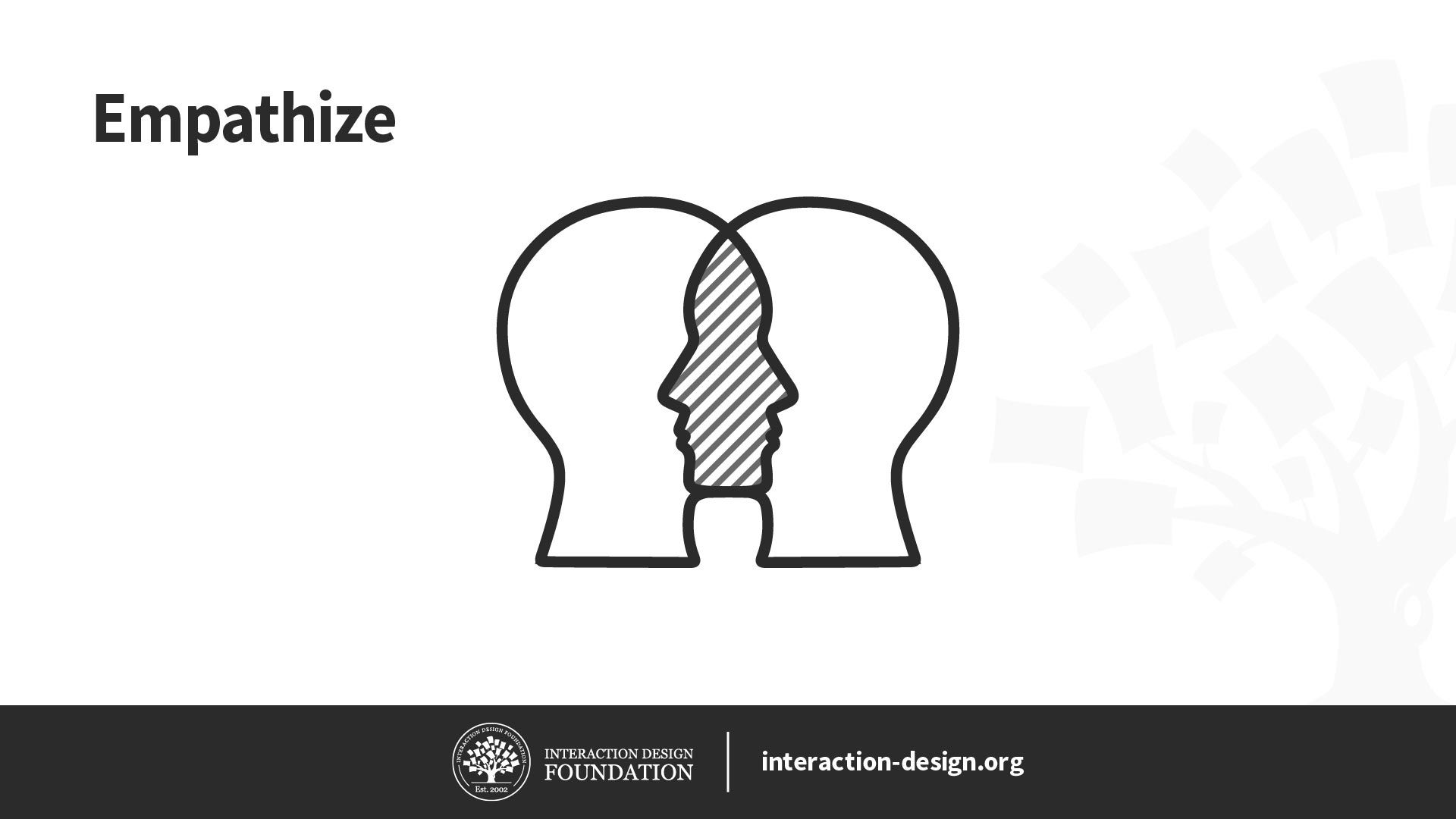
Empathize: the start phase of pattern thinking, where you gain real insight into users and their needs.
© Teo Yu Siang and the Interaction Pattern Foundation, CC BY-NC-SA three.0.
The first stage of the design thinking procedure focuses on user-centric research. You want to gain an empathic understanding of the problem you are trying to solve. Consult experts to find out more about the area of concern and acquit observations to appoint and empathize with your users. Y'all may also want to immerse yourself in your users' concrete environment to gain a deeper, personal understanding of the problems involved—as well every bit their experiences and motivations. Empathy is crucial to problem solving and a man-centered design process equally it allows design thinkers to set aside their own assumptions about the world and gain real insight into users and their needs.
Depending on time constraints, y'all will get together a substantial corporeality of information to apply during the next phase. The primary aim of the Sympathize stage is to develop the best possible understanding of your users, their needs and the issues that underlie the development of the production or service you want to create.
Stage 2: Define—State Your Users' Needs and Issues
Define: the 2d phase of design thinking, where you define the problem statement in a human-centered mode.
© Teo Yu Siang and the Interaction Design Foundation, CC Past-NC-SA 3.0.
In the Define stage, you lot will organize the information yous accept gathered during the Sympathise stage. You lot'll analyze your observations to define the core issues you and your team accept identified up to this point. Defining the problem and problem statement must be washed in a human being-centered manner.
For example, you should not define the problem as your ain wish or need of the visitor: "We need to increment our food-product market place share among young teenage girls by v%."
Y'all should pitch the problem statement from your perception of the users' needs: "Teenage girls need to eat nutritious nutrient in order to thrive, be salubrious and grow."
The Define phase volition help the design team collect great ideas to establish features, functions and other elements to solve the problem at hand—or, at the very least, allow real users to resolve issues themselves with minimal difficulty. In this stage, y'all will start to progress to the third stage, the ideation phase, where yous inquire questions to help you look for solutions: "How might we encourage teenage girls to perform an activity that benefits them and as well involves your company's nutrient-related production or service?" for instance.
Stage 3: Ideate—Challenge Assumptions and Create Ideas
Ideate: the third phase of blueprint thinking, where y'all identify innovative solutions to the problem statement you lot've created.
© Teo Yu Siang and the Interaction Design Foundation, CC By-NC-SA three.0.
During the third stage of the design thinking process, designers are ready to generate ideas. You lot've grown to understand your users and their needs in the Empathize phase, and you've analyzed your observations in the Define stage to create a user centric problem statement. With this solid groundwork, y'all and your squad members can starting time to look at the problem from different perspectives and ideate innovative solutions to your problem statement.
There are hundreds of ideation techniques you can use—such as Brainstorm, Brainwrite, Worst Possible Idea and SCAMPER. Brainstorm and Worst Possible Idea techniques are typically used at the start of the ideation phase to stimulate free thinking and expand the problem space. This allows you to generate as many ideas as possible at the commencement of ideation. You should pick other ideation techniques towards the end of this stage to assistance y'all investigate and test your ideas, and choose the best ones to move forward with—either because they seem to solve the trouble or provide the elements required to circumvent it.
Stage four: Prototype—First to Create Solutions
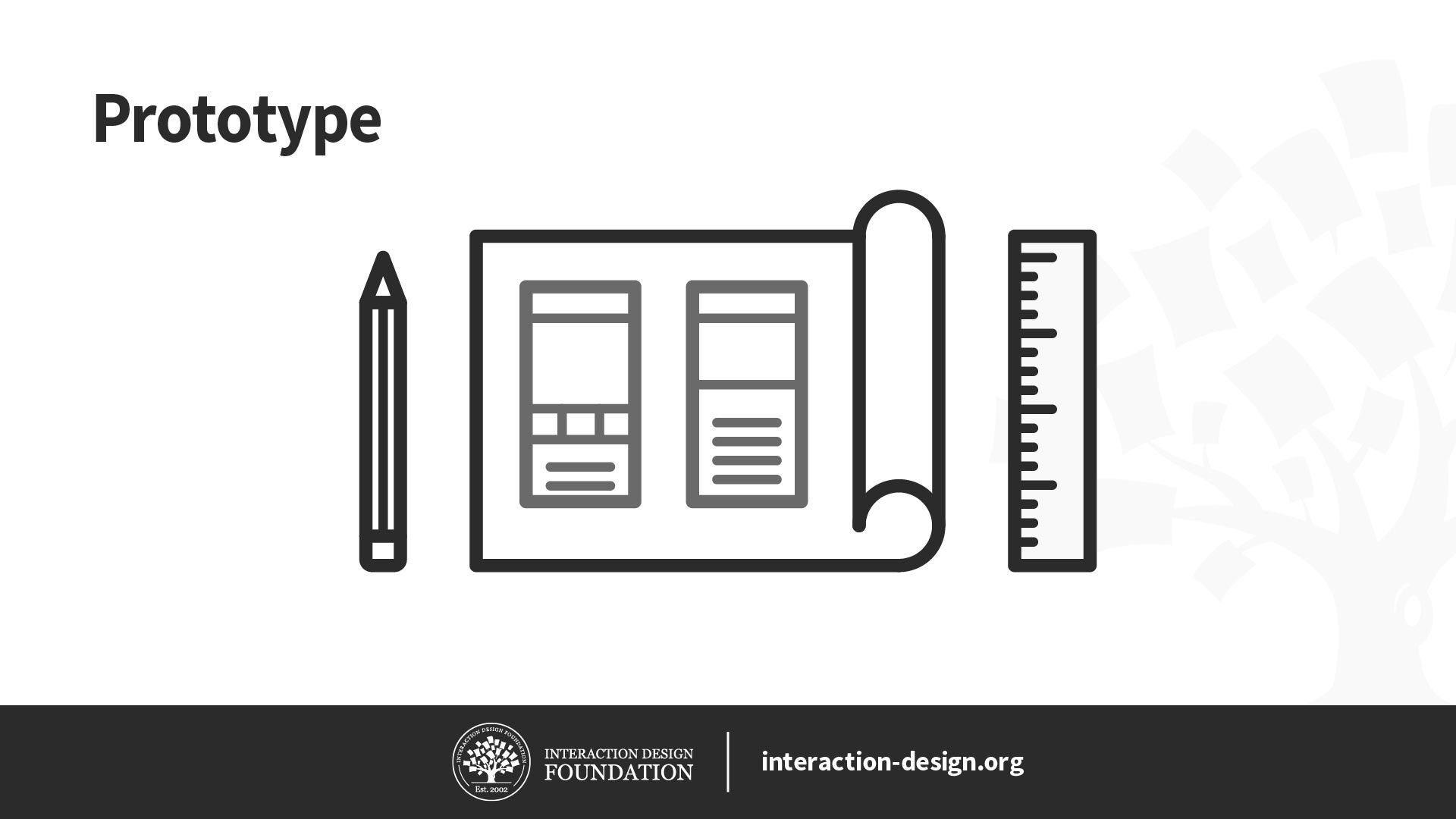
Prototype: the 4th phase of pattern thinking, where you identify the all-time possible solution.
© Teo Yu Siang and the Interaction Design Foundation, CC BY-NC-SA three.0.
The design team volition at present produce a number of cheap, scaled down versions of the product (or specific features constitute within the production) to investigate the primal solutions generated in the ideation phase. These prototypes tin be shared and tested within the team itself, in other departments or on a small group of people outside the design team.
This is an experimental phase, and the aim is to place the best possible solution for each of the problems identified during the starting time three stages. The solutions are implemented within the prototypes and, 1 by ane, they are investigated and then accustomed, improved or rejected based on the users' experiences.
Past the end of the Epitome phase, the design squad will have a better idea of the production's limitations and the problems information technology faces. They'll besides have a clearer view of how real users would behave, remember and feel when they interact with the stop product.
Stage 5: Test—Try Your Solutions Out
Exam: the 5th and final phase of the blueprint thinking procedure, where you lot test solutions to derive a deep agreement of the product and its users.
© Teo Yu Siang and the Interaction Design Foundation, CC BY-NC-SA 3.0.
Designers or evaluators rigorously test the complete product using the all-time solutions identified in the Prototype stage. This is the final stage of the five-phase model; all the same, in an iterative process such as design thinking, the results generated are oft used to redefine one or more further issues. This increased level of understanding may help you lot investigate the atmospheric condition of apply and how people think, behave and feel towards the production, and even atomic number 82 yous to loop back to a previous stage in the blueprint thinking procedure. You tin can then continue with further iterations and brand alterations and refinements to dominion out culling solutions. The ultimate goal is to get as deep an understanding of the product and its users as possible.
Did Y'all Know Design Thinking is a Non-Linear Process?
We've outlined a direct and linear design thinking procedure here, in which one stage seemingly leads to the side by side with a logical conclusion at user testing. Nevertheless, in exercise, the process is carried out in a more flexible and non-linear fashion. For example, different groups within the design team may conduct more than ane stage concurrently, or designers may collect data and paradigm throughout each stage of the project to bring their ideas to life and visualize the problem solutions as they get. What'south more, results from the Exam stage may reveal new insights almost users which lead to some other brainstorming session (Ideate) or the evolution of new prototypes (Image).
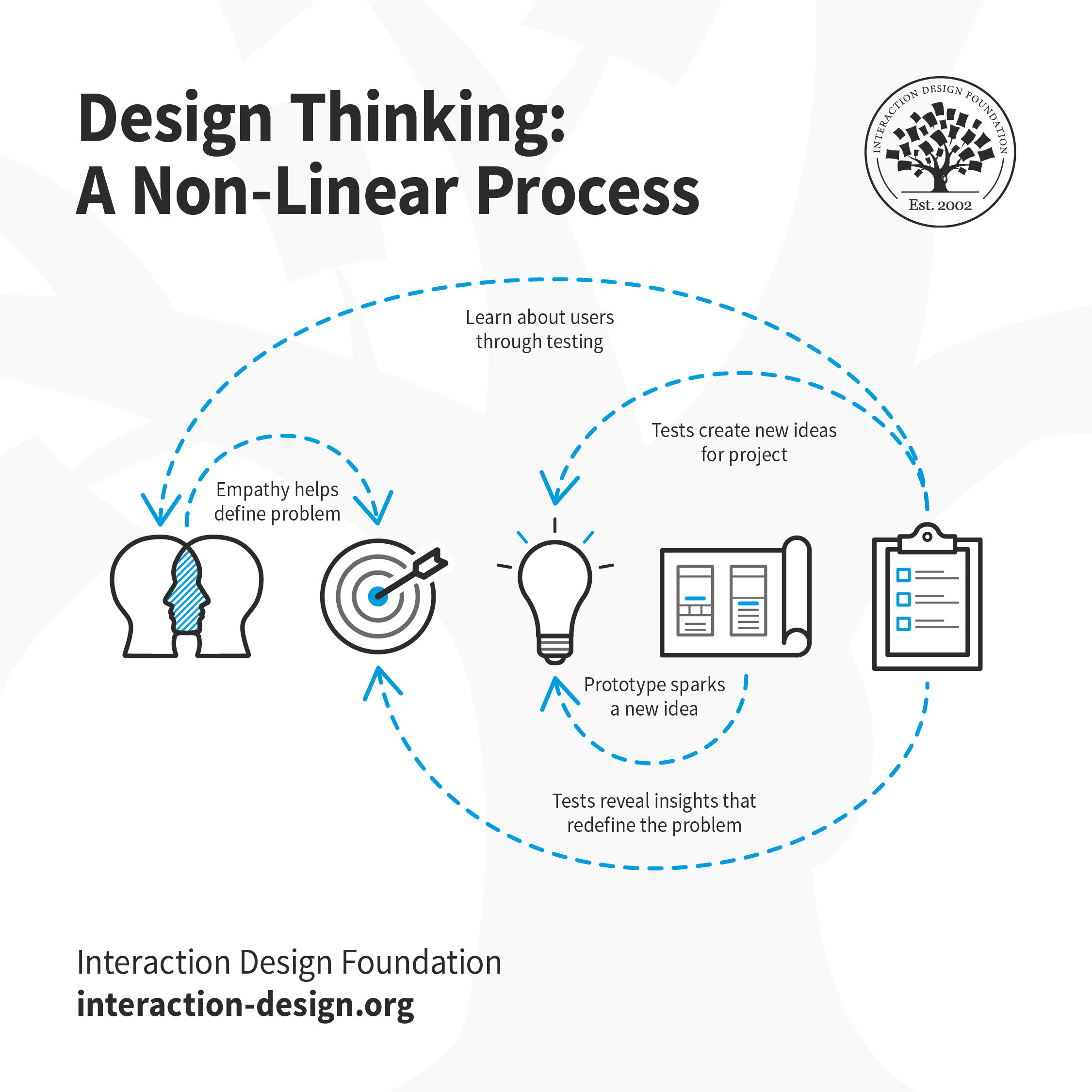
It is important to note the five stages of pattern thinking are not ever sequential. They do not have to follow a specific order, and they can frequently occur in parallel or be repeated iteratively. The stages should be understood every bit dissimilar modes which contribute to the entire design project, rather than sequential steps.
© Teo Yu Siang and the Interaction Pattern Foundation, CC BY-NC-SA three.0.
The blueprint thinking process should non be seen equally a concrete and inflexible approach to design; the component stages identified should serve as a guide to the activities you carry out. The stages might be switched, conducted concurrently or repeated several times to gain the nigh informative insights virtually your users, expand the solution space and strop in on innovative solutions.
This is 1 of the master benefits of the v-phase model. Cognition acquired in the latter stages of the procedure tin can inform repeats of earlier stages. Information is continually used to inform the understanding of the problem and solution spaces, and to redefine the problem itself. This creates a perpetual loop, in which the designers continue to proceeds new insights, develop new ways to view the product (or service) and its possible uses and develop a far more profound understanding of their real users and the issues they face.
The Take Away
Design thinking is an iterative, non-linear process which focuses on a collaboration between designers and users. It brings innovative solutions to life based on how existent users think, feel and behave.
This human-centered design process consists of five cadre stages Empathize, Define, Ideate, Prototype and Test.
It's important to note that these stages are a guide. The iterative, non-linear nature of design thinking means you lot and your blueprint team tin can comport these stages out simultaneously, echo them and even circle dorsum to previous stages at whatsoever point in the pattern thinking process.
References & Where to Larn More
Herbert Simon, The Sciences of the Artificial (3rd Edition), 1996.
d.schoolhouse, An Introduction to Blueprint Thinking PROCESS GUIDE, 2010.
Gerd Waloszek, Introduction to Design Thinking, 2012.
Images
Hero Image: © Daniel Skrok and the Interaction Design Foundation, CC Past-NC-SA 3.0.

First Stage Of A Process,
Source: https://www.interaction-design.org/literature/article/5-stages-in-the-design-thinking-process
Posted by: bergerselmerry.blogspot.com
0 Response to "First Stage Of A Process"
Post a Comment