

How To Play D Chord On Guitar Easy
The D chord is a challenge for new guitar players. Before diving in, make sure your guitar's in tune, y'all're in a comfortable position, and get gear up to larn the D chord!
D Chord Basics
Check out the chord diagram for the D chord. If yous aren't familiar with chord diagrams, cheque out this lesson here.
Retrieve, the dots on the chord diagram are where you're going to put your fingers. Additionally, the numbers stand for which fingers get where.
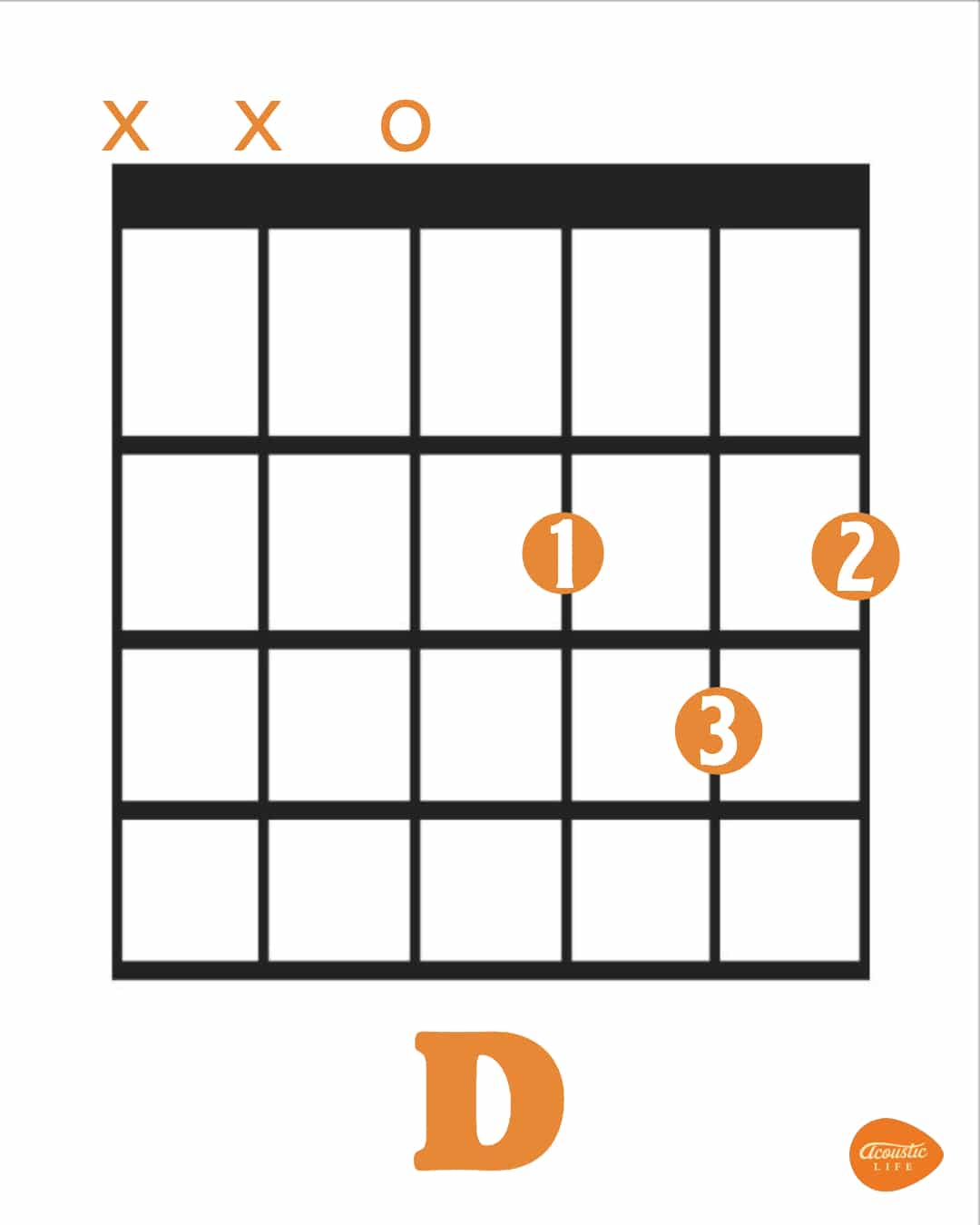
To get-go, effort placing your fingers on the fretboard based on the chord charts. As I talked most the video lesson, it's helpful to place your fingers ane at a time, starting with your index (1st) finger.
While this isn't crucial for forming the D chord, it works for many students.
- 1st finger (index) on the 2nd fret of the Yard string.
- 2nd finger (middle) on the 2nd fret of the high Due east string.
- third finger (ring) on the third fret of the B string.
Don't forget to place your fingers merely behind the fret. Whether you're playing the D chord or any other chord, if y'all place your fingers directly on the frets, you'll accept a muted annotation. If y'all place your fingers besides far back, you won't be able to utilise enough force per unit area, resulting in a buzzing noise.
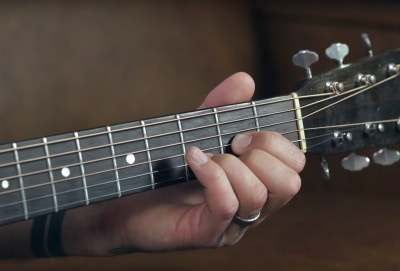
The D chord can create discomfort in your fingers when y'all first play it. Your fingers may not be able to stretch or get them in the place you want them to—and that's okay for now!
Fortunately, if your fingers will become accustomed to playing the D chord. The important matter is to manage the tension in your fingers and your wrist. Check out my lesson on managing tension hither.
Less tension=greater flexibility and execution in your playing.
Another "hurting-point" guitarists experience when playing the D chord is the bending of their fingers. You want to brand sure you're fretting on the tips of your fingers rather than the soft pads. This will reduce your fingers accidentally muting some other string.
Finally, I want you lot to check on the joints of your fingers. Make sure each joint is Not locked out — there should be a curve in each joint of your finger.
Managing Your Thumb
When you lot commencement play the D chord, try to keep your pollex on the back of the fretboard. Don't permit your finger creep over to the meridian of the fretboard!
- Use the pad of your thumb on the neck of the guitar.
- Rest your pollex in-between the eye of the neck and the low E cord (the thickest string).
- Exercise NOT permit your palm rest on the cervix of the guitar!
For the D chord, you lot want to brand sure there is an arch in your fingers. Because your fingers are crammed into the 4th, 5th, and 6th strings, having a high curvation will prevent accidentally muting other strings.
When your palm rests on the neck (which you lot DO Not want to practice!) you lose the arch in your fingers.
What Strings Practice You Play for the D Chord?
The D chord uses the D, G, B, and Eastward strings (quaternary, third, 2nd, and 1st strings). That ways that you lot don't want to play the two thickest strings (the A and low E cord) for the D chord.
If you're e'er unsure, check back on the chord diagram. Think, the Xs mean that you don't play those strings, while the Os mean you play that cord open.
Now that y'all have your fingers placed, attempt strumming down with your selection or thumb towards the basis. Get-go with the D cord and smoothly strum all the way through the high Eastward string.
Equally you strum, think about where you are starting the strum. I know I'm packing on the details, but keeping these things in listen will help your playing grow farther down the line.
Information technology's totally fine to "go wild" and strum abroad on the D chord. Don't ignore that urge! Yet, when y'all're in practice fashion — that is, when you are learning something new and want to improve on it — exist cognizant of the strings you lot plucking.
If you aren't careful about what strings you play for the D chord, you'll end upwardly with a muddy, unclear, and anomalous chord.
Does your D Chord Sound similar this?
If your D chord doesn't sound like this, don't panic! Yous can brand some adjustments that I'll tell you well-nigh in the next section.
How to Play the D Chord with Articulate Notes
Hither'south a quick D chord checklist to make certain if your fingers are in the right identify.
- Are your fingers touching other strings? If so, make certain you're playing with the tips of your fingers and you have an curvation in your fingers.
- Practice Not let your palm rest on the neck of the guitar!
- Offset your strum on the D string…practice Not play the A or depression Eastward strings.
The most common D chord issue guitarists have lies in the ring finger. Ofttimes, the ring finger touches the high E string, which accidentally mutes information technology. Trust me, you desire that high East cord to ring out!
To remedy this D chord problem, focus on bringing more arch in your ring finger and ensure you're playing with the tip of your ring finger.
Another D chord event is having discomfort in the index finger. It seems like an extreme angle to have your alphabetize finger on the second fret of the loftier E string, but your fingers will go accustomed to it. Additionally, attempt to allow for a small space betwixt the fingertip of your alphabetize finger and the fretboard.
D Chord Exercise #i: The Quick Draw
The D chord can be a difficult chord to retrieve, particularly if you desire to employ the aforementioned fingers on the same frets and strings every time.
To help call up how to play the D chord, I use the quick draw exercise. To help enforce the muscle retentiveness for making the D chord, the quick describe exercise helps tremendously.
The quick draw practice provides just enough pressure and positive stress to motivate you to focus on getting your fingers in the right place with precision. Furthermore, this exercise tin exist done equally slow or as fast as y'all want!
To practice the quickdraw chord exercise, start with your mitt on your leg. So, count downwards from five to null.
In those five seconds, identify your fingers in the D chord position. Once you count to zero, strum the chord.
Ideally, you'll have a total and resonant chord. If y'all didn't go it the offset time, that's alright. Learning the guitar takes fourth dimension. If y'all get the hang of the 5-2d intervals, try taking that down to iii-second countdowns.
Alternate Fingerings
As yous continue to play the D chord, yous might ask, "Tony, why can't I use different fingers for the D chord?"
Lucky for y'all, there are many unlike ways to play the D chord. While I propose you lot offset with the prescribed fingering, you may detect that other fingerings are more comfortable. Due to mobility issues like arthritis or tendonitis, you may find that information technology'due south easier to use your own fingering.
I utilize the suggested fingering because it helps in chord transitions and limits defoliation during transitions. While it might seem difficult at showtime, go ahead and try to use the suggested fingering first earlier branching out into alternate fingerings.
Managing Blisters and Hurting for the D Chord
The bad news: I'd be a liar if I told y'all your fingertips won't hurt when you starting time playing the D chord.
Near likely, if you're new to guitar, your fingertips are going to be soft. When you lot printing them against the metallic strings of your guitar, yous're tearing up your fingers a little flake. You might end upwardly with a blister, or, if you're lucky, your fingers volition merely feel sore.
The expert news: everyone who plays a string instrument goes through this — eventually, you'll gain callouses and your fingers won't hurt as bad.
The key is to not push yourself too much when you're playing the D chord or anything on the guitar. Play until you can experience the soreness in your fingertips, and after that, residuum for a bit.
It might have a month or two for your fingers to become used to beingness pressed confronting the strings, depending on how oftentimes you play. Just recollect that it is normal to feel this soreness, and to have breaks if it gets besides painful!
D Chord Exercise #2: Strength Exercise
If you're looking for means to increase the strength in your fretting hand and wrist, exist certain to check out this D chord strength do.
This D chord exercise is one of my favorites for two reasons…
- It's incredibly musical and fun to play.
- This D chord exercise promotes strength and stamina in your fretting manus.
Having strength and agility in your fretting mitt is necessary for creating a make clean and resonant D chord. If you experience comfy playing the D chord and are fix for a little more of a claiming, follow along with the exercise in the video below!
What's Next?
Now that you've been introduced to the D chord, it's time to outset learning another chords!
Be sure to check out the Ultimate Guide to Learning Guitar if yous're looking for a fun, free, online introduction to the guitar.
If you need some more guidance, daily exercises, and a robust community of acoustic guitar geeks, cheque out the 30 Days to Play Claiming here.

How To Play D Chord On Guitar Easy,
Source: https://acousticlife.tv/how-to-play-d-chord-on-guitar/
Posted by: bergerselmerry.blogspot.com
0 Response to "How To Play D Chord On Guitar Easy"
Post a Comment